

What does a credible path to net zero actually look like for a commercial building, and how quickly can you model it? Eight Versa put Building Atlas to the test on their own office, turning a real asset into a live proof of concept.
About Building Atlas
Building Atlas is an AI-powered software platform designed to help commercial real estate owners, asset managers, and investors accelerate energy efficiency retrofits, manage Minimum Energy Efficiency Standards (MEES) compliance, and achieve net zero goals, at any scale.
Whether you manage a single building or a portfolio of hundreds, the platform delivers actionable retrofit insights using just a building address, no detailed surveys or design inputs required. For portfolio managers, this means rapid, cost-efficient screening across an entire estate. For individual property owners or landlords, it provides a clear, jargon-free roadmap to improve performance, reduce bills, and stay on the right side of regulation. The platform scales to the user, not the other way around.
Building Atlas acts as an analytical engine, presenting multiple energy retrofit scenarios alongside their projected EPC ratings, return on investment, capital expenditure (CAPEX), and payback periods. Where half-hourly metered data is available, it can be entered to surface patterns invisible to static compliance calculations: baseload waste, out-of-hours consumption, and system inefficiencies that drain performance and profitability.
The Regulatory Landscape: Why Acting Now Matters
The pressure on commercial property owners in England and Wales has never been greater. Under the existing MEES regulations, commercial properties must hold a minimum EPC E rating to be legally let. The government has signalled an intention to raise that threshold to EPC B by 2030 for new leases and 2033 for all tenancies; a step-change that will render a large proportion of the existing stock unlettable without meaningful retrofit investment.
Beyond MEES, the Future Buildings Standard is expected to tighten requirements further, and growing lender and investor scrutiny around embodied carbon, energy performance certificates, and climate risk is reshaping valuations. For building owners across the UK, from a single leasehold office in a regional town to a multi-asset institutional portfolio, understanding the cost and impact of retrofit is no longer optional planning. It is urgent commercial due diligence.
This is precisely where Building Atlas delivers value: cutting the time and cost of early-stage feasibility from weeks to minutes, and giving decision-makers the data they need to act with confidence.
This Case Study
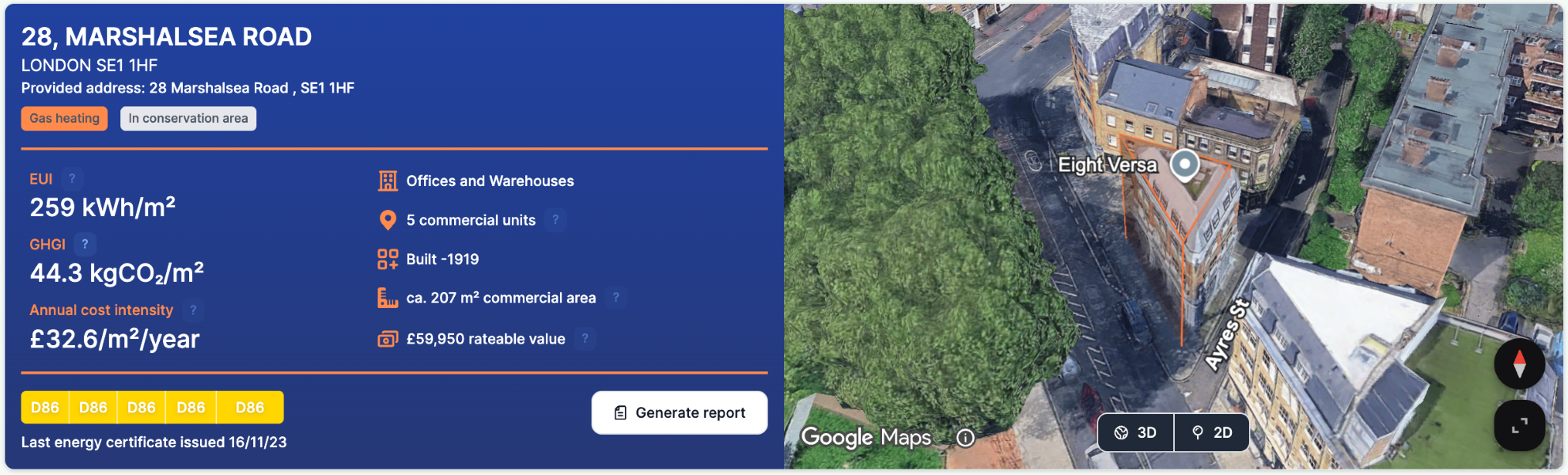
As part of Eight Versa’s partnership with Building Atlas, our own office building was used as a live test asset and demonstration case study, allowing both teams to validate the platform’s insights against real energy data. The objective was to understand how different retrofit and improvement strategies impact energy performance, financial returns, and carbon outcomes, and to do so at the speed and cost typical of an early commercial appraisal. What stood out from the platform’s energy model, built from the address alone and without any site survey or detailed inputs, is that it predicted our actual metered consumption to within a few percent – a level of accuracy that meaningfully raises the bar for what early-stage modelling can be expected to deliver, and that underpins the credibility of everything that follows from it.
Two distinct pathways were modelled and compared: a compliance-led MEES scenario and a more ambitious net zero-aligned strategy. The contrast between them reveals not just the difference in outcomes, but the difference in long-term thinking.
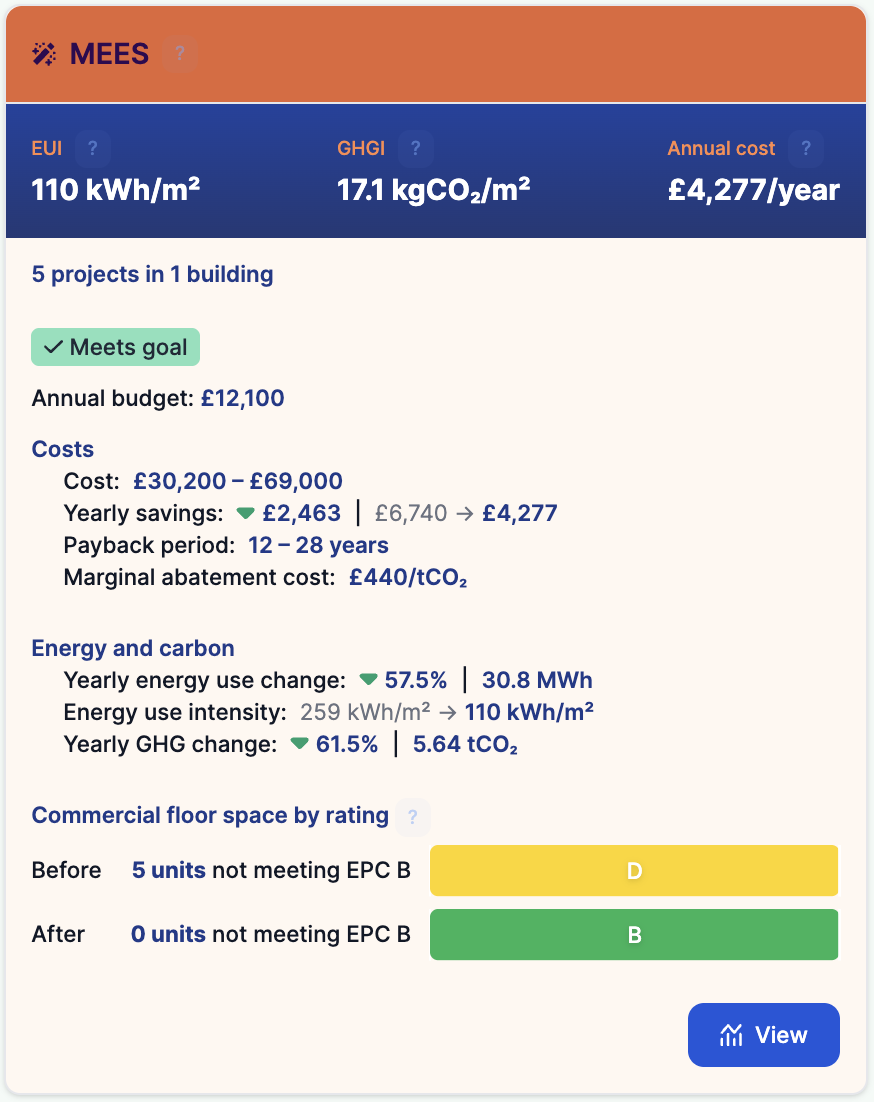
Scenario 1: MEES Compliance Pathway
The MEES scenario represents a targeted, compliance-led retrofit strategy doing what is necessary to meet minimum regulatory requirements, without pursuing full decarbonisation. It is the ‘floor’ of ambition, not the ceiling.
Key outcomes:
- EPC rating improved from D to B, meeting anticipated future MEES thresholds.
- Energy Use Intensity (EUI) reduced from 259 kWh/m² to 110 kWh/m².
- Annual energy use reduced by 57.5%.
- Operational carbon emissions reduced by 61.4%.
- Annual energy costs cut to approximately £4,277; a saving of £2,463 against the £6,740 baseline.
- Five fabric improvement projects, with capital costs ranging from £30,200 to £69,000.
- Payback periods of 12 to 28+ years, reflecting the compliance-focused rather than value-optimised nature of this approach.
This pathway keeps the building legally lettable under tightening regulations, but leaves significant energy savings and carbon reductions on the table. For owners with limited capital or shorter investment horizons, it may be the pragmatic first step, but it should be understood as just that: a first step.
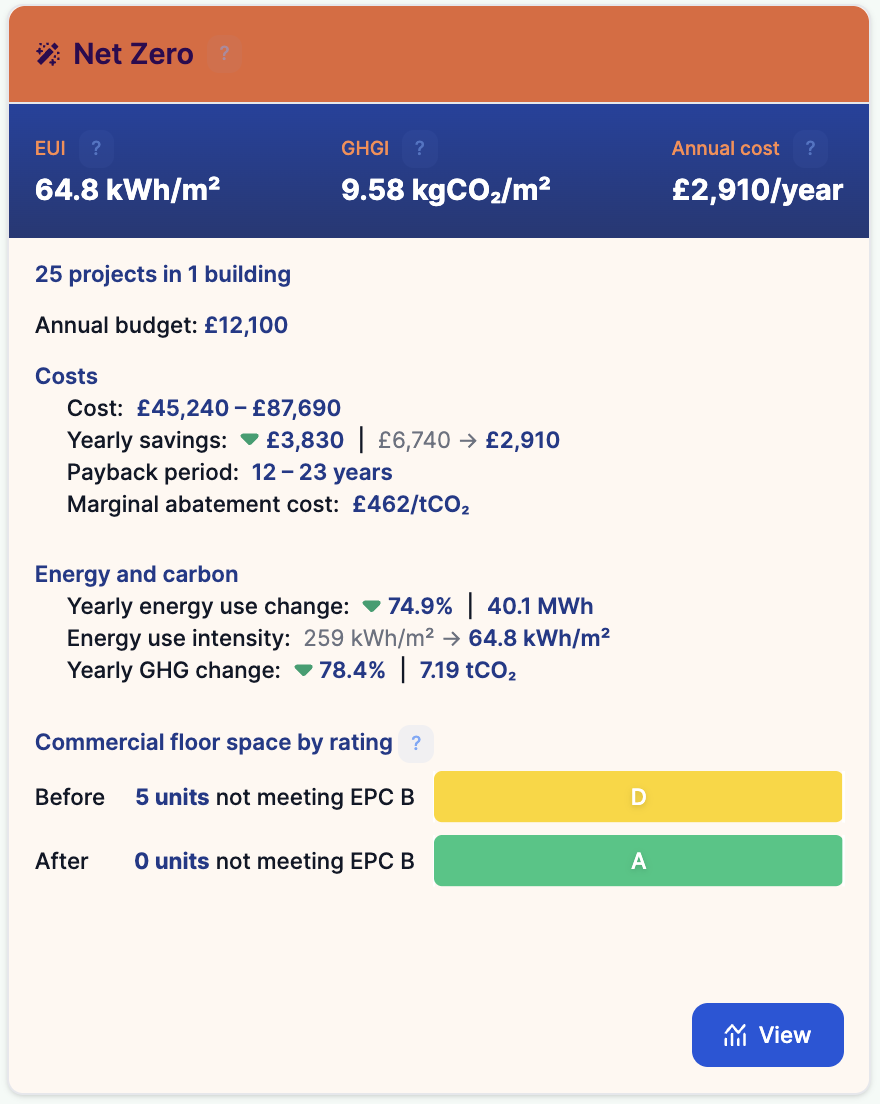
Scenario 2: Net Zero-Aligned Pathway
The net zero scenario represents a more comprehensive and future-facing decarbonisation strategy, aligned with long-term climate targets, best-practice building performance, and the direction of travel for both regulation and investor expectations.
Key outcomes:
- EPC rating improved from D to A.
- Energy Use Intensity reduced from 259 kWh/m² to 64.8 kWh/m², a 74.9% reduction.
- Operational carbon emissions reduced by 78.4%.
- Annual energy costs cut to approximately £2,910; a saving of £3,830 per year.
- 25 integrated improvement measures across fabric, digital controls, smart thermostats, and energy monitoring.
- Capital costs ranging from £45,240 to £87,690, with payback periods of 12 to 23 years.
While the upfront investment is higher, the net zero pathway delivers superior long-term value: greater energy savings, a stronger carbon profile, a future-proofed EPC A rating, and a building equipped with the smart monitoring infrastructure to maintain performance over time. For institutional investors, ESG-focused funds, and owners planning to hold assets beyond 2030, this is the scenario that protects and enhances long-term value.
Impact at Scale: From Single Assets to National Portfolios
The UK’s commercial building stock represents one of the largest untapped opportunities for carbon reduction in the economy. Millions of buildings offices, retail units, light industrial premises remain far below the performance standards that regulation and the market will soon demand. Closing that gap requires tools that can work at scale.
Building Atlas is built for exactly that. A single landlord with one investment property can use it to understand their exposure, model retrofit costs, and build a business case for improvement, all without commissioning a full energy audit. A portfolio manager overseeing hundreds of assets can use the same platform to prioritise interventions by risk, cost, or carbon impact, and present credible decarbonisation roadmaps to lenders, investors, or board-level stakeholders.
This scalability is what sets Building Atlas apart. The insight it delivers in minutes for a single building can be replicated systematically across a portfolio of any size – transforming what has historically been an expensive, slow, asset-by-asset process into a quicker, more informed way to make decisions.
Conclusion: Uncertainty is Becoming More Expensive
This case study demonstrates that the question for commercial building owners is no longer whether to retrofit; regulation, market forces, and the cost of energy have settled that debate. The question is how to retrofit intelligently: choosing the right measures, at the right time, with a clear understanding of the financial and carbon trade-offs involved.
Building Atlas, supported by Eight Versa’s advisory expertise, provides a powerful and practical solution for rapid feasibility assessment, compliance screening, and early-stage net zero planning. By turning complex data into clear options the software allows for stronger stakeholder engagement, and a more confident path forward, whether that journey starts with a single building or spans an entire national portfolio. As occupiers of the building in this study, we can say that the recommendations reflect what we know about how it performs – the identification of fabric inefficiencies and the projected reduction in Energy Use Intensity from 215 to 51 kWh/m² are consistent with our own experience of the building, not the output of a generic template applied from a distance.
The buildings that stay competitive over the next decade will be the ones whose owners started planning in this one. Building Atlas makes that planning accessible to everyone.


